Starting an indoor garden is easier than you might think, and this Indoor Gardening Guide will help you begin with the basics.
Indoor gardening can look complicated when you first get into it. There are different plants, potting mixes, containers, fertilizers, grow lights, watering schedules, and plenty of advice that seems to contradict itself.
The good news is that you do not need to understand all of it before growing your first plant.
For most beginners, indoor gardening starts much more simply: choose a suitable plant, find a reasonable spot for it, use an appropriate container and growing medium, and learn how to observe what the plant needs.
You also do not need a large collection of plants. A small windowsill, shelf, kitchen corner, or desk can be enough to begin.
This guide covers the basic principles of indoor gardening for beginners, with an emphasis on starting small and learning as you go.
A quick note: Indoor plants vary considerably by species and growing conditions. The advice here is intended as a practical starting point rather than a universal care formula. When in doubt, check the specific requirements of the plant you are growing.
What Is Indoor Gardening?
Indoor gardening simply means growing and caring for plants inside a home or another enclosed space.
That can include several different approaches:
-
Growing ornamental houseplants
-
Keeping herbs on a kitchen windowsill
-
Growing small vegetables indoors
-
Starting seedlings before moving them outdoors
-
Growing succulents and cacti
-
Propagating plants
-
Growing microgreens
-
Using containers or small planters around the home
For a beginner, there is no need to choose the most sophisticated approach.
A few small houseplants in suitable containers are already an indoor garden.
The important thing is to match the plant to the conditions you actually have rather than trying to recreate an outdoor garden inside your home.
Why Start Small?
One of the easiest mistakes in indoor gardening is starting with too much.
It is tempting to buy several plants at once, arrange them around the house, and try to learn everything immediately. But every plant can have different preferences for light, watering, humidity, temperature, pot size, and soil.
Starting with one or two plants makes those differences easier to understand.
You can observe:
-
How quickly the soil dries
-
How much light reaches the plant
-
Whether new leaves are developing
-
How the plant reacts after watering
-
Whether the container is suitable
-
How much attention the plant realistically needs
This gives you experience without turning your first attempt into a large project.
As you become more comfortable, you can gradually add more plants or experiment with herbs, propagation, larger planters, or supplemental lighting.
The Four Basics Every Beginner Should Understand
Although different plants have different requirements, most indoor gardening comes back to a few basic factors:
-
Light
-
Water
-
Growing medium
-
Container and drainage
Temperature, humidity, nutrients, airflow, and other factors can matter too, but these four are a useful place to begin.
The order is also important.
A plant that needs bright light will not necessarily become healthy simply because you water it correctly. Likewise, a container with poor drainage can create problems even when everything else seems reasonable.
1. Start by Understanding the Light in Your Home
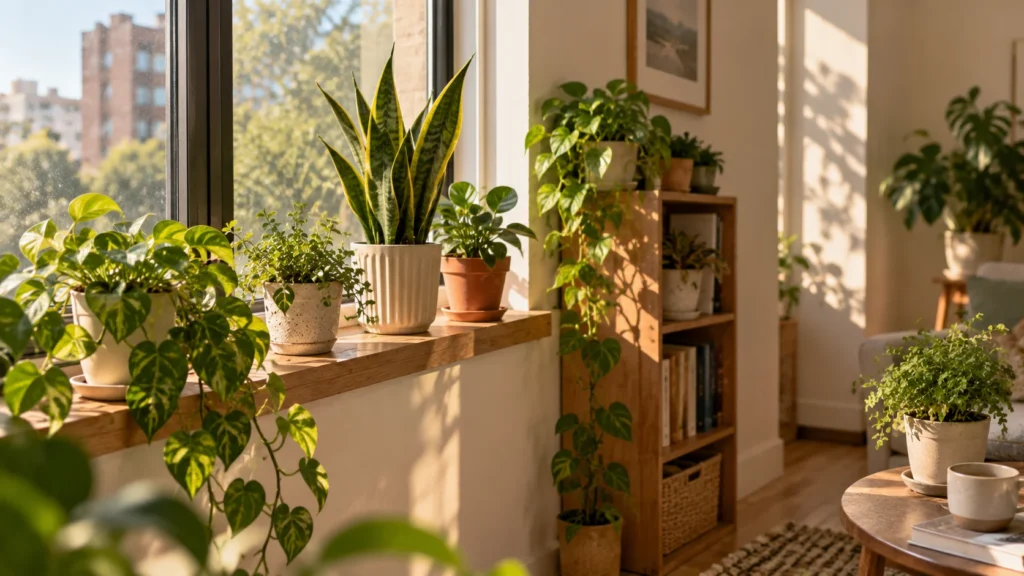
Light is one of the first things to consider before choosing an indoor plant.
A common beginner mistake is choosing a plant first and only afterward trying to find somewhere to put it.
It is usually easier to reverse that process.
Look around your home and notice where natural light enters.
You might have:
-
A bright south-facing window
-
Gentle morning light near an east-facing window
-
Strong afternoon light near a west-facing window
-
A north-facing window with less direct sunlight
-
A bright room where the plant is several feet from a window
-
A relatively dark corner that may need supplemental lighting
The exact conditions vary with location, season, window size, curtains, nearby buildings, and even the position of the plant inside the room.
Texas A&M AgriLife Extension notes that many houseplants perform well with appropriate light, and that east-, south-, and west-facing windows can provide different levels of sunlight intensity.
Direct, Indirect, and Low Light
You will often see indoor plants described as requiring:
-
Bright direct light
-
Bright indirect light
-
Medium light
-
Low light
These descriptions can be useful, but they should not be treated as exact measurements for every home.
“Low light” does not mean “no light.”
A plant still needs enough light to support its normal growth. A room that feels bright to your eyes may provide much less usable light for a plant than you might expect.
If you are unsure, observe the location during different parts of the day before buying a plant.
That simple step can prevent many problems later.
A Simple Rule for Beginners
Instead of asking:
“Where should I put this plant?”
Try asking:
“What plants are suitable for the light I already have?”
That small change makes plant selection much easier.
2. Choose Beginner-Friendly Plants
There is no single list of plants that will work for every beginner.
The best first plant is usually one whose requirements fit your home and your routine.
If you have a bright windowsill, your choices may be different from someone living in a dim apartment.
If you often forget to water, a plant with relatively forgiving watering needs may be easier than a plant that requires consistently moist conditions.
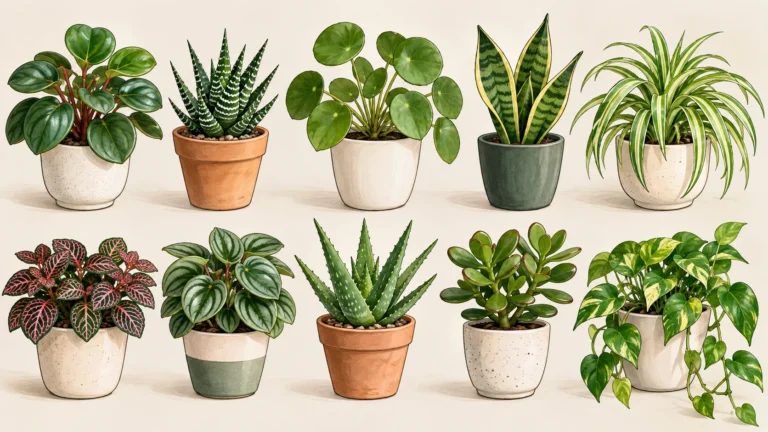
Some commonly recommended beginner houseplants include:
-
Pothos
-
Snake plants
-
Spider plants
-
ZZ plants
-
Peperomia
-
Certain philodendrons
-
Many common succulents
These plants are frequently discussed as approachable options for new indoor gardeners, but “easy” does not mean impossible to kill. A plant can still struggle when its basic requirements are not met.
The important lesson is not to memorize a list of supposedly indestructible plants.
Instead, learn to match:
Plant → Light → Container → Watering routine
That skill becomes more useful as your collection grows.
For a closer look at plant selection, see our upcoming guide on easy indoor plants for beginners.
3. Pick the Right Container
A planter is more than decoration.
The container affects how much growing medium surrounds the roots, how quickly the medium dries, and how excess water leaves the pot.
For beginners, one feature deserves particular attention:
Choose Containers With Drainage
A drainage hole allows excess water to leave the container.
This matters because consistently waterlogged growing medium can create an unfavorable environment for roots.
That does not mean every plant needs the same type or size of pot. Some plants prefer to dry somewhat between waterings, while others have different moisture requirements.
The container should therefore be considered together with the plant and growing medium.
Does a Bigger Pot Mean Better Growth?
Not necessarily.
A very large container holds more growing medium, which can stay wet for longer after watering. A pot that is too small can also restrict the root system or dry out quickly.
For beginners, it is usually better to avoid dramatically oversized containers and choose a size appropriate for the plant.
The exact ideal size depends on the species, root system, growth habit, and current container.
What About Decorative Planters?
Decorative planters can work well indoors, particularly when you want your plants to complement your room.
However, it is useful to distinguish between:
-
A growing pot, where the plant and growing medium are placed
-
A cachepot or decorative planter, which may simply hold another pot
This approach can make watering and maintenance easier while still giving you the appearance you want.
4. Understand Potting Mix
Indoor plants generally benefit from a growing medium designed for containers rather than simply using soil taken from outside.
Why?
Container environments are different from garden beds.
In a garden, water can move through a much larger volume of soil. In a pot, the entire root environment is limited to a relatively small container.
A suitable indoor potting mix is generally designed to provide a balance between:
-
Moisture retention
-
Drainage
-
Air around the roots
-
Physical support
Different plants may need different mixes.
For example, a tropical houseplant and a cactus do not necessarily need the same growing medium.
Beginners do not need to create complicated custom soil recipes immediately. A suitable commercial potting mix can be a practical starting point, provided it fits the type of plant you are growing.
5. Learn How to Water Indoor Plants
Watering is probably one of the first things new plant owners worry about.
“How often should I water?”
Unfortunately, there is no single schedule that works for every indoor plant.
A fixed calendar can be misleading because watering needs change with:
-
Plant species
-
Pot size
-
Growing medium
-
Light levels
-
Temperature
-
Humidity
-
Season
-
Root development
-
Container material
A plant sitting beside a sunny window in a small pot may dry much faster than the same species in a larger container in a cooler room.
Check Before You Water
Instead of automatically watering every few days, check the growing medium and consider the plant’s specific requirements.
Depending on the plant, you might:
-
Feel the surface of the growing medium
-
Check deeper into the pot with your finger
-
Lift the container to notice changes in weight
-
Observe the plant itself
-
Follow the care guidance for that particular species
The goal is not to keep the soil permanently wet.
It is also not to let every plant become completely dry.
The right approach depends on the plant.
For more detail, our indoor plant watering guide can cover this topic separately.
Avoid Watering by Habit
One of the easiest habits to develop is watering simply because it is “watering day.”
Instead, make checking your plants part of the routine.
You might inspect them when:
-
Making coffee
-
Cleaning the room
-
Opening curtains
-
Checking your desk
-
Watering another plant
A short observation can tell you more than a generic schedule.
6. Give Your Plants the Right Amount of Humidity
Humidity can become a confusing subject because indoor plants come from many different environments.
Some tropical species may appreciate higher humidity, while many common houseplants can adapt to normal household conditions.
You do not necessarily need a humidifier to keep indoor plants.
Before buying additional equipment, consider whether your plants are actually showing signs that their environment is unsuitable.
You can also group plants with similar preferences, avoid placing sensitive plants directly beside heating or cooling vents, and pay attention to seasonal changes.
The important point is to avoid treating humidity as a universal problem that every indoor gardener must solve with equipment.
7. Temperature and Airflow Matter Too
Most homes provide a reasonably stable environment for common houseplants, but extreme or rapidly changing temperatures can still cause problems.
Avoid placing plants directly beside:
-
Heating vents
-
Air-conditioning vents
-
Drafty doors
-
Very cold windows during winter
-
Appliances that produce significant heat
Airflow also matters.
Indoor spaces can sometimes have stagnant air, particularly when many plants are crowded together.
You do not need to turn your home into a greenhouse. Simply giving plants enough space and maintaining normal room airflow is often a sensible starting point.
Indoor Gardening for Beginners: A Simple First Setup
If you want to begin without buying a lot of equipment, keep the first setup basic.
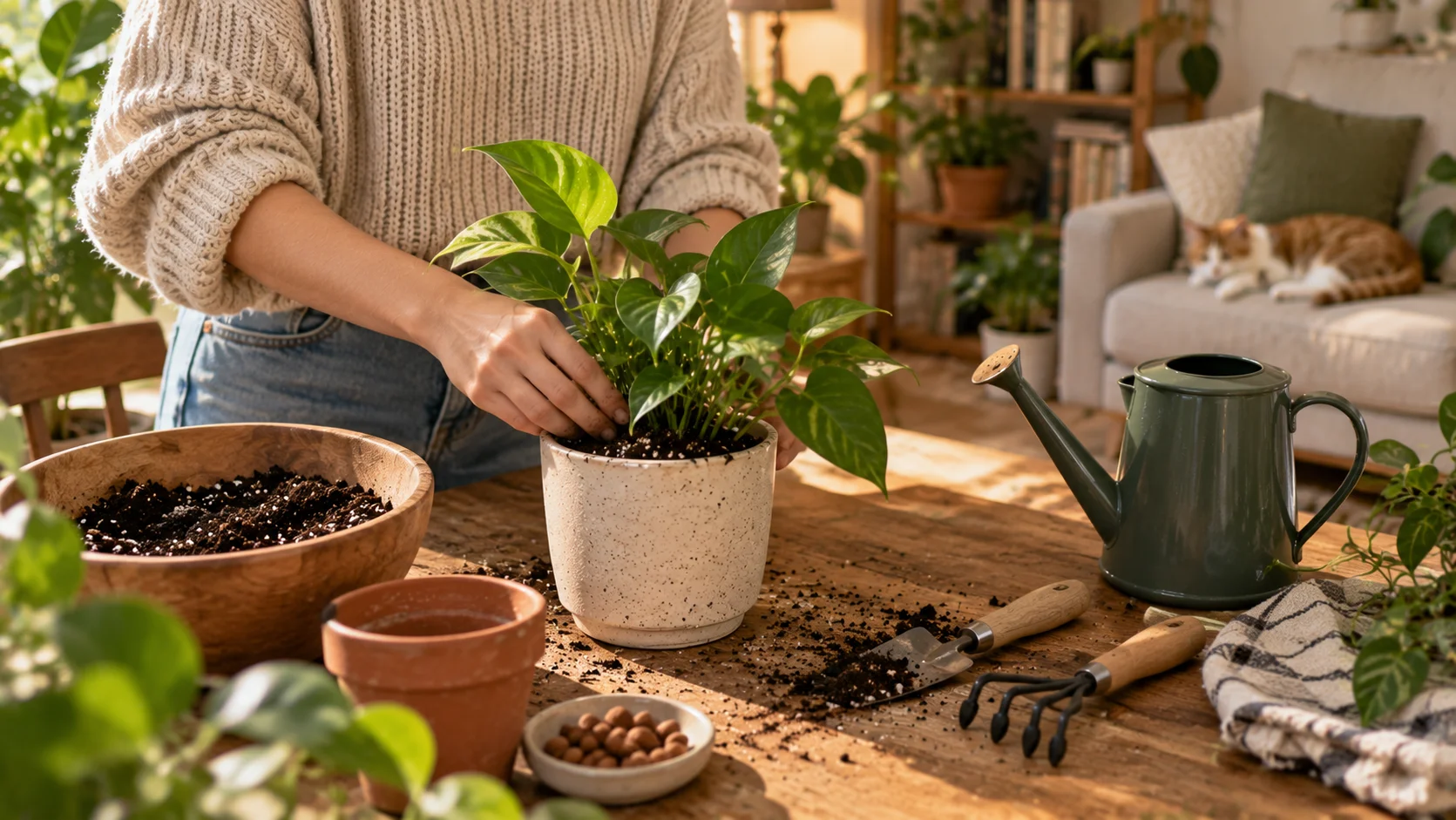
A practical beginner setup might include:
-
One or two easy-care plants
-
Suitable containers
-
Indoor potting mix
-
A small watering can or similar tool
-
A bright, appropriate location
-
A saucer or tray to protect indoor surfaces
That is enough to start learning.
You can add other equipment later if your plants or growing goals require it.
A Simple Step-by-Step Indoor Gardening Setup
Step 1: Choose Your Space
Start with the area rather than the plant.
Look for a location where you can comfortably place, inspect, and water the plant.
A windowsill, shelf, desk, kitchen corner, or small plant stand can all work depending on the light.
Step 2: Observe the Light
Spend a day or two noticing how the light changes.
Ask:
-
When does direct sunlight reach this area?
-
Does the area stay bright throughout the day?
-
Is the plant behind a curtain?
-
Does another building block sunlight?
-
Does the light change significantly during different seasons?
You do not need laboratory-level measurements for your first plant.
You simply need a reasonable understanding of the environment.
Step 3: Choose a Plant That Matches
Now select a plant based on the conditions you have.
This is more reliable than buying a plant you like visually and hoping it adapts.
If you have limited light, look for plants known to tolerate lower-light indoor conditions.
If you have a bright window, you have a different set of options.
Step 4: Select the Container
Choose a container that suits the plant and provides appropriate drainage.
Think about both function and appearance.
A small planter can be enough for a compact plant, while a larger plant will naturally require more room.
Step 5: Use Appropriate Potting Mix
Use a growing medium suited to the plant.
Avoid assuming that all plants need the same soil.
Step 6: Water According to the Plant
After planting, learn how quickly the growing medium dries.
Rather than immediately creating a strict watering calendar, observe what happens.
This is one of the easiest ways to begin understanding your particular indoor environment.
Step 7: Observe Before Changing Things
Give the plant time to settle.
If something looks different, do not immediately add fertilizer, move the plant three times, repot it, and change the watering schedule all at once.
Change one thing at a time when possible.
That makes it easier to understand what actually helped.
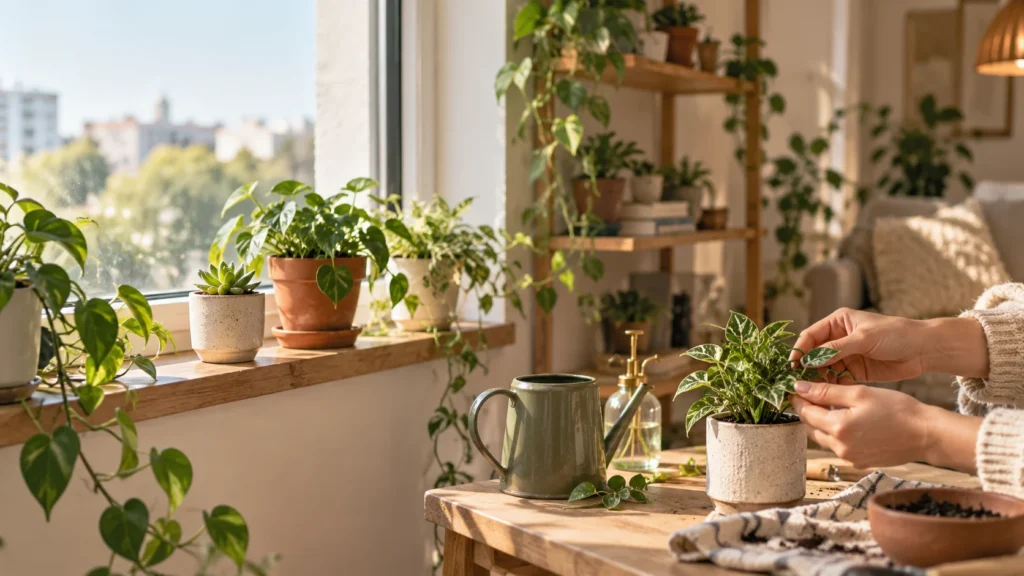
Common Indoor Gardening Mistakes Beginners Make
You do not need to avoid every mistake to become a good indoor gardener.
Some mistakes are part of learning.
However, a few are especially common.
Choosing Plants Without Considering Light
A plant may look perfect in a store or online but struggle in your home.
The problem is often not the plant itself.
It may simply be in the wrong location.
Watering on a Fixed Schedule
“Every Sunday” sounds simple, but plants do not always follow calendars.
Environmental conditions change, so checking the plant and growing medium is generally more useful than blindly following a schedule.
Using a Pot Without Adequate Drainage
A decorative container may look attractive, but if excess water has nowhere to go, watering becomes more difficult to manage.
Buying Too Many Plants at Once
A large collection can quickly become difficult to understand.
Starting with one or two plants gives you an opportunity to learn without creating a maintenance problem.
Changing Too Many Things at Once
If a plant looks unhealthy, beginners sometimes respond by changing its location, watering more often, adding fertilizer, changing soil, and repotting it all at once.
That makes diagnosis harder.
Start with the basics.
Check light, moisture, roots, container, and the plant’s normal requirements before making several changes.
Assuming Every Problem Is Caused by Water
Water is important, but yellow leaves, slow growth, drooping, or leaf damage can have several possible causes.
Light, pests, temperature, root problems, nutrient issues, age, and natural growth patterns may also play a role.
Avoid diagnosing a plant from one symptom alone.
How to Tell When Something May Be Wrong
Your plants will not always look perfect.
A few changes may simply be part of normal growth, while others can indicate environmental stress.
Watch for changes such as:
-
Persistent wilting
-
Yellowing leaves
-
Brown or crispy leaf edges
-
Soft or damaged stems
-
Slow or weak growth
-
Unusual spots
-
Pests around leaves or stems
-
Soil that remains wet for unusually long periods
These symptoms are clues rather than automatic diagnoses.
For example, yellow leaves do not always mean “too much water.” The cause depends on the plant and the conditions around it.
When something changes, go back to the basics:
Light → Water → Growing medium → Container → Temperature → Pests
That simple checklist can help narrow down the possibilities.
Should Beginners Use Grow Lights?
Not necessarily.
If your home already provides suitable natural light, a grow light may not be needed.
But some homes simply do not receive enough usable natural light for the plants someone wants to grow.
In that situation, supplemental lighting can be useful.
Grow lights come in many forms, from small lights for individual plants to larger systems designed for multiple plants.
The key is to treat artificial lighting as a tool for solving a specific problem rather than an automatic requirement for indoor gardening.
If you are considering one, first determine:
-
Which plants need additional light
-
How much natural light the location receives
-
How many plants you want to support
-
How much space you have
-
Whether the setup needs to be portable or permanent
For a small collection, a simple setup may be enough.
Can You Grow Food Indoors?
Yes, although the possibilities depend heavily on light, space, containers, and the type of crop.
Indoor gardening can include edible plants such as:
-
Basil
-
Mint
-
Parsley
-
Chives
-
Lettuce
-
Microgreens
-
Some compact vegetables
Herbs and leafy greens can be approachable options for beginners because they can fit into relatively small spaces.
However, growing food indoors is not identical to keeping decorative houseplants.
Edible crops may have greater light requirements, faster growth, and different nutritional needs.
If your main goal is fresh food, plan around the crop rather than simply using ordinary houseplant advice.
Indoor Gardening in a Small Apartment
You do not need a large home to start an indoor garden.
Small spaces can actually encourage a simpler approach.
Consider using:
-
Windowsills
-
Narrow shelves
-
Small plant stands
-
Kitchen counters
-
Empty corners
-
Wall-mounted solutions where appropriate
The main limitation is usually not the number of possible locations.
It is the amount and quality of light available.
A compact collection of healthy plants is generally more useful than filling every available surface with plants that cannot thrive there.
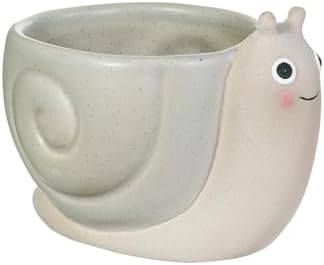
This is where small planters can be especially practical. They allow you to experiment with plants without committing an entire room to gardening.
How Many Plants Should a Beginner Start With?
There is no official number.
For someone completely new to indoor gardening, one to three plants can be a perfectly reasonable starting point.
That gives you enough variety to learn without creating a large maintenance routine.
You might choose:
-
One low-maintenance foliage plant
-
One plant with different light requirements
-
One small herb or edible plant
After a few weeks or months, you will have a better idea of how much time you actually want to spend caring for plants.
Then you can expand naturally.
A Beginner’s Indoor Gardening Routine
Indoor gardening does not have to become a daily chore.
A simple routine might look like this:
A few times a week
Take a quick look at your plants.
Check for:
-
Drooping
-
New growth
-
Pests
-
Major leaf changes
-
Dry or unusually wet growing medium
When watering is needed
Water according to the plant’s requirements rather than automatically following the same schedule for every plant.
Every few weeks
Look at the overall arrangement.
Ask whether plants are still receiving suitable light and whether they have enough space.
Occasionally
Clean dusty leaves where appropriate and inspect stems, leaves, and the surface of the growing medium.
This routine takes little time once it becomes familiar.
How to Make Indoor Gardening More Enjoyable
Indoor gardening is not only about keeping plants alive.
Part of the appeal is creating a small living environment that fits naturally into your home.
You might group plants by:
-
Light requirements
-
Size
-
Leaf shape
-
Color
-
Container style
-
Room function
Small planters can work particularly well on shelves, desks, windowsills, and other areas where a full-sized container would feel out of place.
But aesthetics should come after basic plant needs.
A beautiful arrangement is much easier to maintain when the plants are already in locations where they can grow reasonably well.
When Should You Repot an Indoor Plant?
Repotting is useful, but it is not something every plant needs immediately.
A plant may eventually need a new container if:
-
Roots are becoming severely crowded
-
The plant is becoming unstable
-
The current container no longer supports healthy growth
-
The growing medium has deteriorated
-
Watering behavior has changed significantly
However, repotting a healthy plant simply because you bought it is not always necessary.
Give the plant time to adjust to its new environment first, unless there is a clear reason to change the container.
For a deeper look at this subject, see our guide to when and how to repot indoor plants.
Do Indoor Plants Need Fertilizer?
Plants need nutrients, but more fertilizer does not automatically mean more growth.
The right approach depends on the species, growing medium, plant age, and growing conditions.
Some commercial potting mixes already contain nutrients, while others provide little nutrition.
Instead of treating fertilizer as a mandatory part of every watering routine, learn what your particular plant requires.
If you do use fertilizer, follow the product directions and the recommendations for the plant rather than assuming that a stronger dose will produce better results.
A Simple Beginner Checklist
Before buying your first indoor plant, run through this checklist:
Space
-
Where will the plant live?
-
Is the surface stable?
-
Can you easily reach it for watering?
Light
-
How bright is the location?
-
Does it receive direct sunlight?
-
Does the light change during the day?
Plant
-
Does its light requirement match your space?
-
How large can it eventually become?
-
Does its watering preference fit your routine?
Container
-
Is it an appropriate size?
-
Does it provide suitable drainage?
Growing medium
-
Is it appropriate for the plant?
Maintenance
-
Can you realistically care for it?
If you can answer these questions, you already have the foundation for a reasonable first setup.
The Best Way to Learn Indoor Gardening
There is a lot of information about houseplants online, and it can become overwhelming surprisingly quickly.
One source says to water every week.
Another says to wait until the soil is dry.
One person recommends misting.
Another says it is unnecessary.
Someone else recommends a particular soil recipe for every plant.
The reason advice can differ is that indoor gardening is highly dependent on context.
Different plants, homes, containers, climates, and routines produce different results.
Rather than looking for one universal rule, learn the underlying principles.
Ask:
What does this plant need?
What conditions do I have?
What is changing?
What evidence do I have that the plant is struggling?
That mindset will take you further than memorizing a long list of rules.
Start Small, Then Grow From There
The easiest way to make indoor gardening feel manageable is to resist the urge to make it complicated from the beginning.
You do not need a room full of plants.
You do not need expensive equipment.
You do not need a perfect watering schedule.
You need a plant that suits your space, an appropriate container, suitable growing medium, enough light, and a willingness to observe.
Start with one small plant.
Learn how it behaves.
Then add another when you feel ready.
Over time, you will naturally become better at recognizing what your plants need, which locations work in your home, which containers suit your routine, and which types of plants you actually enjoy growing.
That is the real foundation of indoor gardening for beginners: not getting everything right on the first attempt, but building a simple system that you can understand and maintain.
Explore More Indoor Gardening Guides
If you are continuing your indoor gardening journey, these related guides can help you take the next step:
-
Easy Indoor Plants for Beginners
-
How Much Light Do Indoor Plants Need?
-
Indoor Plant Watering Guide
-
How to Choose the Right Planter for Indoor Plants
As the Mini Planter library grows, these supporting guides can help you explore individual parts of indoor gardening without turning the basics into something unnecessarily complicated.
Final Thoughts
Indoor gardening is easier to approach when you stop trying to learn everything at once.
Start with the space you already have. Understand its light. Choose a plant that fits those conditions. Give it a suitable container and growing medium, then pay attention to how it responds.
Some plants will thrive.
Some may struggle.
You will occasionally make the wrong choice or water at the wrong time.
That is normal.
The goal is not to create a perfect indoor garden immediately. It is to learn enough from each plant that the next one becomes a little easier.
Start small, observe often, and let your indoor garden develop at a pace that works for you.